Tires
Use PSI - start with matching front/rear pressureThis note standardizes tire pressure in PSI. Use the table below as the starting point by compound, and move heavier cars toward the high side.
UNOFFICIAL EXPERIMENT NOTE
A working note for reading measured tune values from LetzeLU and Nalak28, one public K1Z Bard sample, observation notes, and supporting theory as separate layers.
Meta tuner values are the anchor. Supporting checks are used only to see whether a setup has drifted too far.
Back to homeThis document was not written by the meta tuners. Do not copy it blindly.
This is only a working note built from public values and limited observations. It may be wrong.
AI-assisted English translation. The Korean original is the reference version, and tuning terms may still need manual review.
TUNING ORDER SUMMARY
This note standardizes tire pressure in PSI. Use the table below as the starting point by compound, and move heavier cars toward the high side.
The Nalak28-style approach keeps much of the base gear set, uses Final Drive compression to spot upper gears that stick out, then uses Final Drive again to set the final overall length.
Front/rear camber is the important part. Toe and caster are treated like fixed starting values.
This is close to a fixed rule.
Start spring rate around one-third to one-half of the slider. The Nalak28 and K1Z Bard samples repeatedly lean toward stronger rear springs than front springs.
This is close to the midpoint of the meta-tuner samples. K1Z Bard's 9.8/9.8 rebound and 3.0/3.0 bump is a firmer reference point at about bump x3.27.
Put front aero at the Acceleration end, then use rear downforce to balance Aero Balance, Acceleration, Top Speed, and lateral G together.
Use 50/100 as the default starting point. Only special cases should need small Brake Balance or Pressure changes.
RWD has no center diff. LetzeLU uses rear 50/0, while Nalak28 often lands around rear 100/0-4. The K1Z Bard AWD sample, rear 100/5 and center 85, still fits the observed range.
TIRE PRESSURE PSI
Forza Guide, Hokihoshi, and Johnson Racing references standardized to PSI
| Compound | Starting point | How to read it |
|---|---|---|
| Slicks | 30 PSI | Reference range: 28-32.5 PSI. High-grip tires naturally sit higher; move heavier cars toward the upper end. |
| Semi-Slicks | 28.5 PSI | Reference range: 27-29.5 PSI. Starting a little below Slicks, like LetzeLU's E-Ray at 27.6 PSI, best fits the three sources. |
| Stock / Street | 25.5 PSI | Reference range: 24-26.5 PSI. Treat this as the general road/street starting point. |
| Rally Tire baseline | 25 PSI | Reference range: 24-26.5 PSI. For normal grip use, both Forza Guide's baseline theory and LetzeLU's 620R rally tire value at 24.7 PSI sit on the lower-pressure side. |
| Rally Tire PI-efficiency | 32.5 PSI* | This is the Nalak28-style exception: using rally tires at higher pressure on road for PI efficiency. The samples sit around 2.2-2.3 BAR, about 31.9-33.4 PSI, usually near 2.3 BAR. |
| Drift | 26.5 PSI | Reference range: 22.5-32 PSI. Raise it if the car refuses to rotate; lower it if it lacks grip. |
| Off-Road Tire PI-efficiency | 21 PSI* | For road builds that use off-road tires for PI efficiency. Reference range: 20-21 PSI. Start high because response and stability matter more than bump absorption here. |
| Off-Road / Cross Country | 18 PSI | Reference range: 15.5-21 PSI. This is the true dirt/cross-country starting point. Lower it if the car bounces over rough ground; raise it if there is more pavement or the response feels soft. |
| Drag | 15 PSI | Reference range: 15 PSI. Treat this only as a drag-specific starting point. |
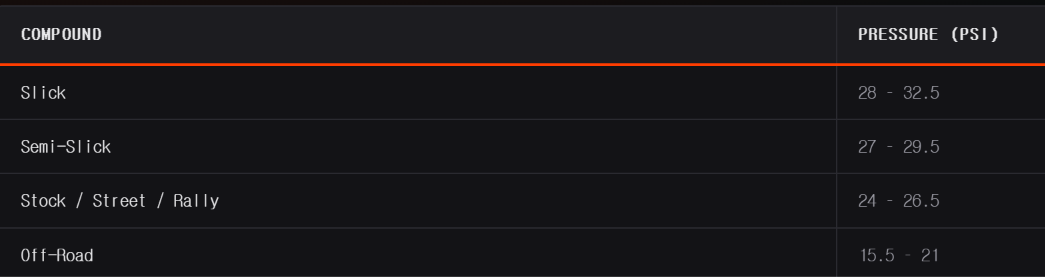
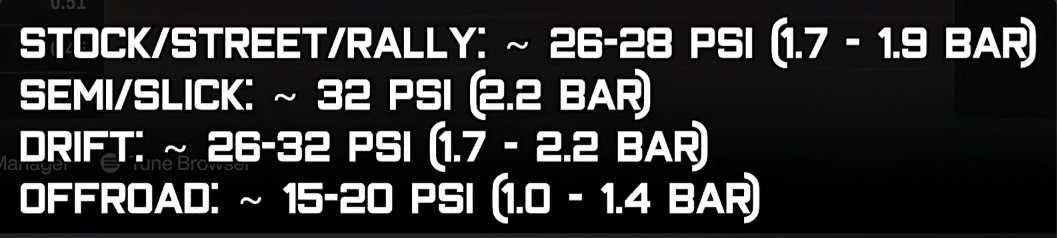
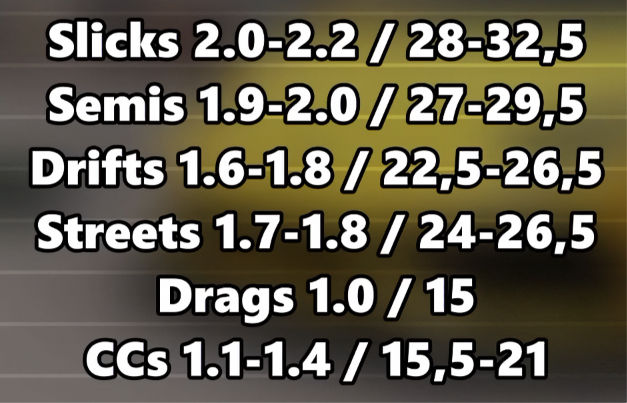
Prioritize the measured LetzeLU/Nalak28 values first. Supporting balance checks are only for catching setups that drift too far, not for overturning meta tuner patterns.
STYLE COMPARISON
| Area | LetzeLU style | Nalak28 style | How to read it |
|---|---|---|---|
| Alignment | -0.6 / -0.3 / 0 / 0 / 7.0 | -0.9 / -0.5 / 0 / 0 / 7.0 | The Nalak28 style uses deeper camber. Toe and caster both look like stable fixed values. |
| ARB | Front 1 / Rear 65 | Front 1 / Rear 65 | Both styles share the same road-meta rotation pattern: soften the front, lock down the rear. The K1Z Bard Viper at 13.5/65 is the exception. |
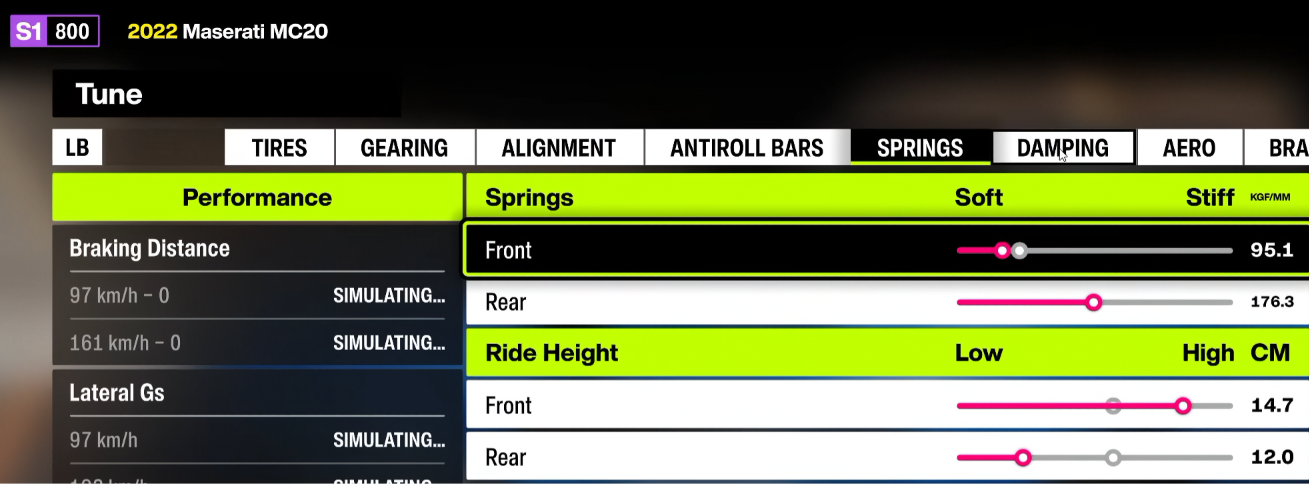
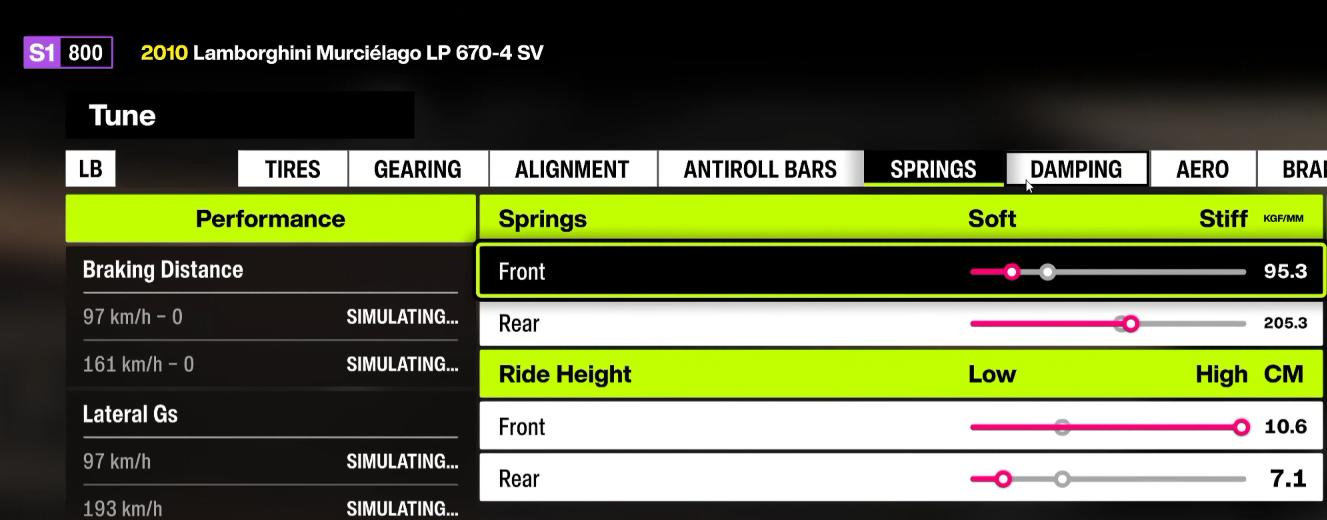
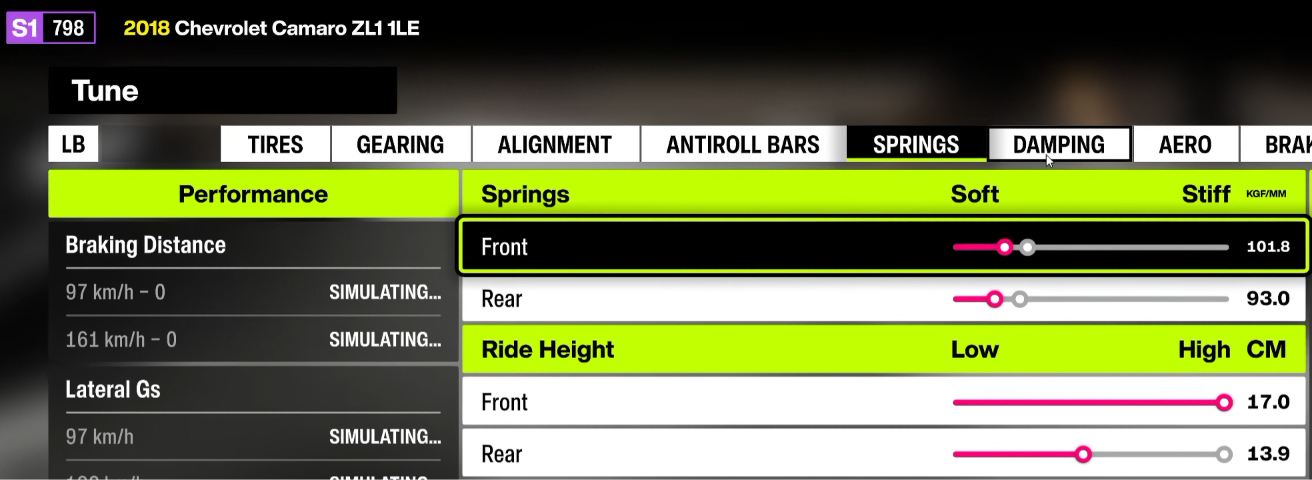
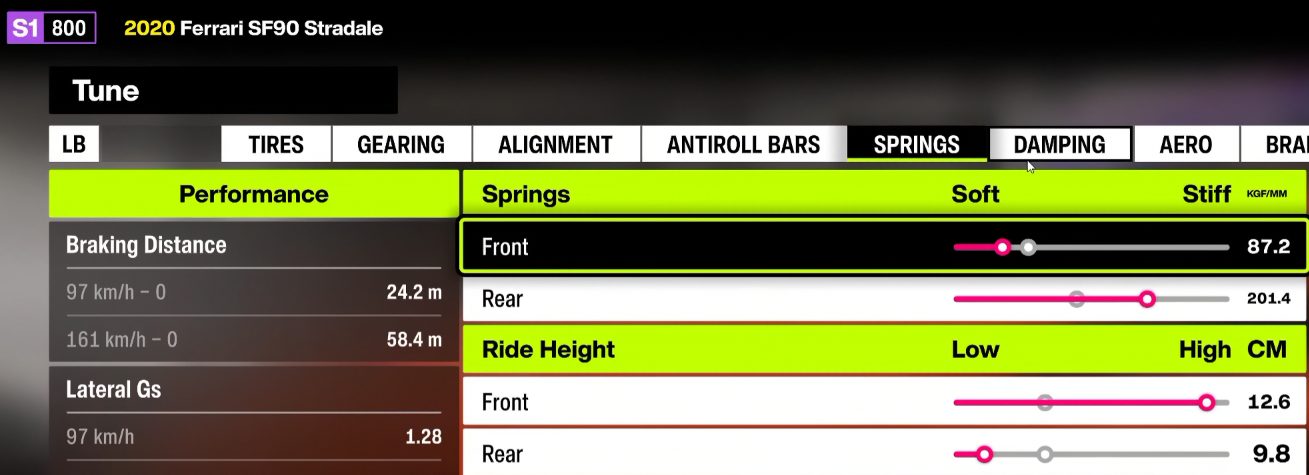
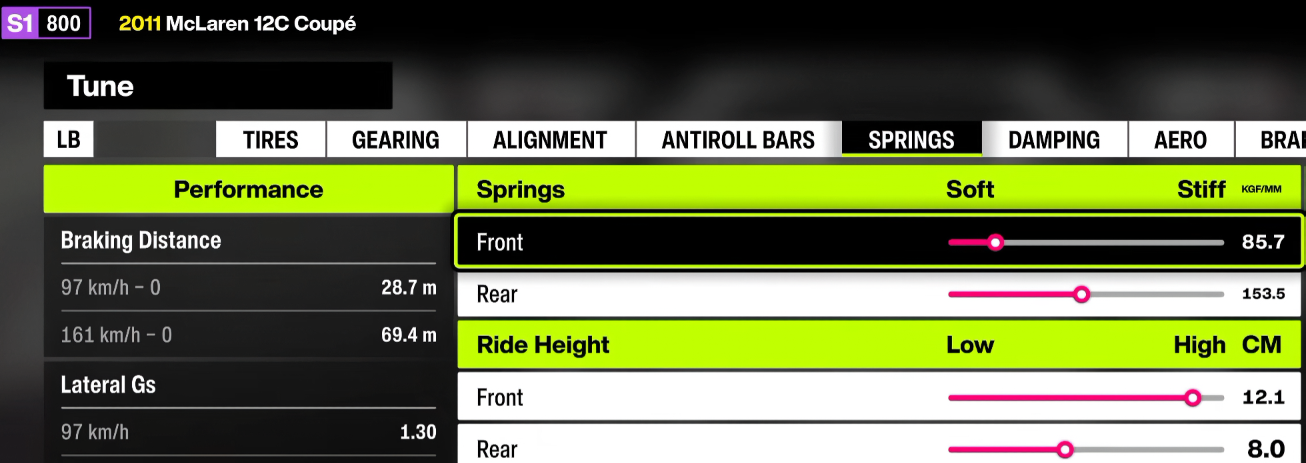
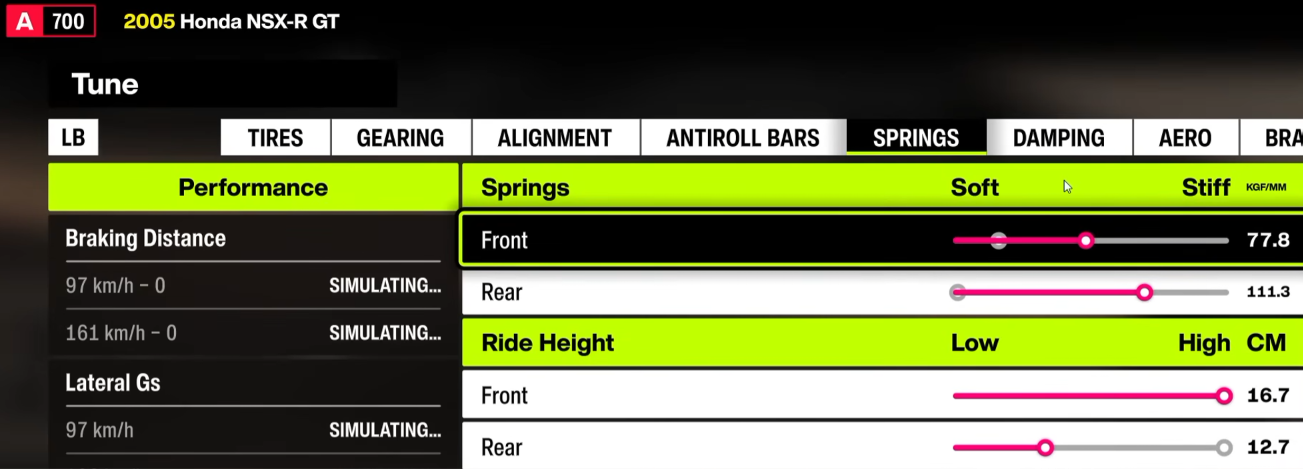
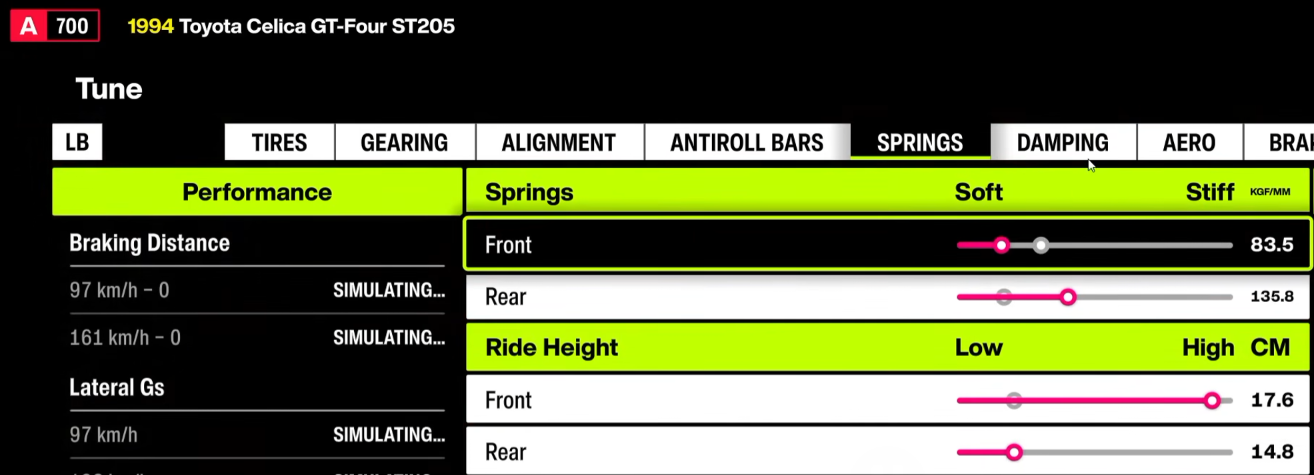
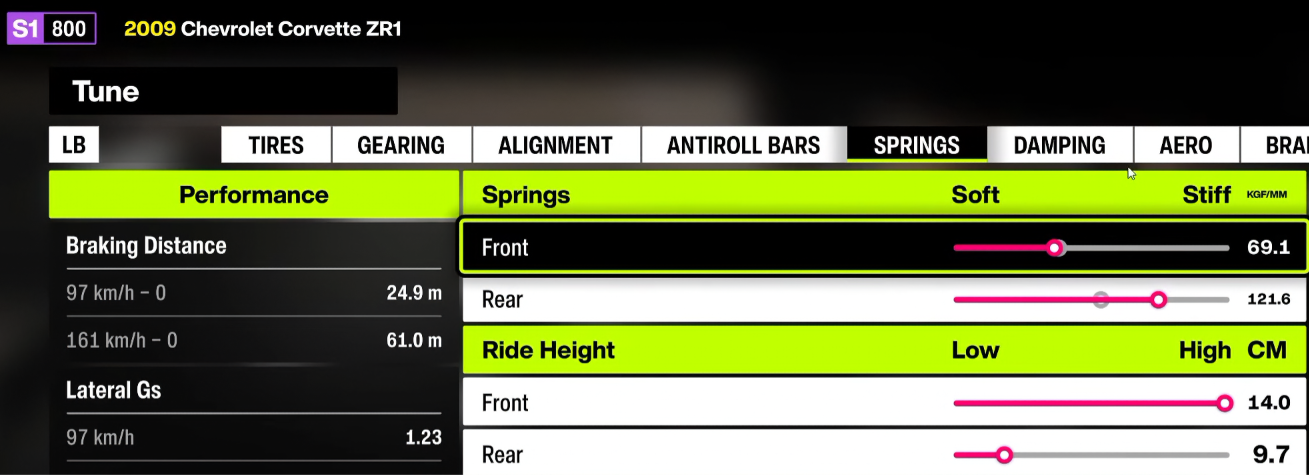
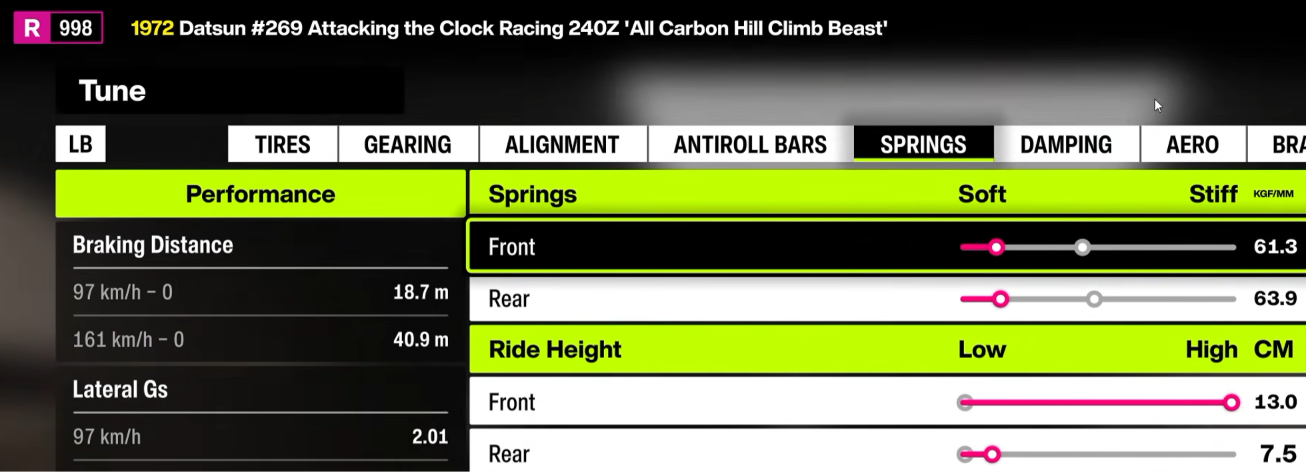
| Springs / Ride Height | Ride F max / R min, F-R 3.6~4.5cm | Front ride height held at max; F-R usually 2.7-4.3 cm; rear spring tends stronger | The Nalak28 sample center is around 3.1-3.5 cm. K1Z Bard's Viper has equal front/rear ride height, but rear spring is 2.35x, so it still supports the stronger-rear-spring pattern. |
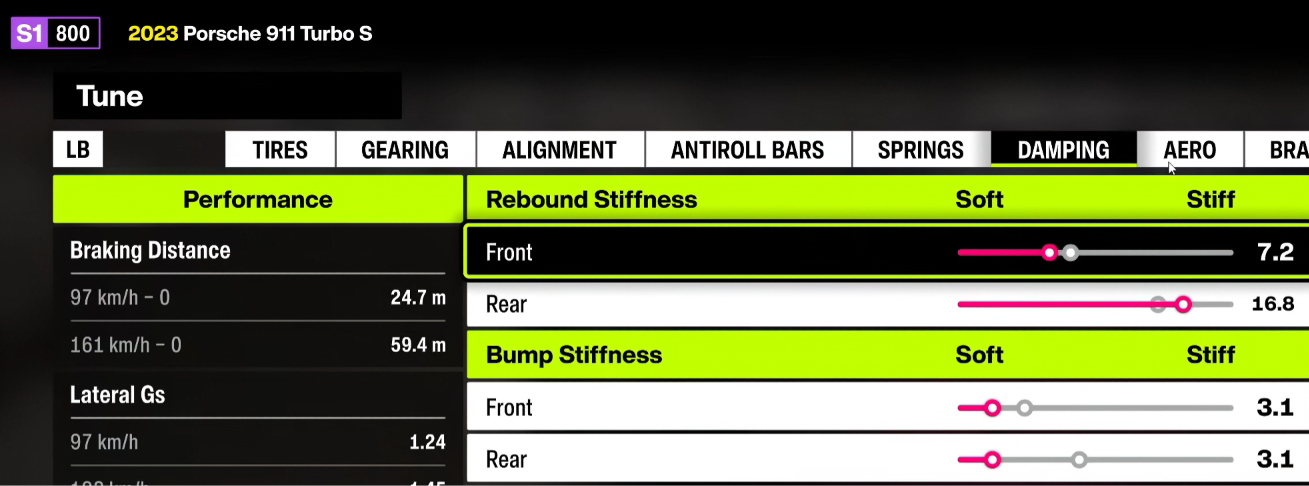
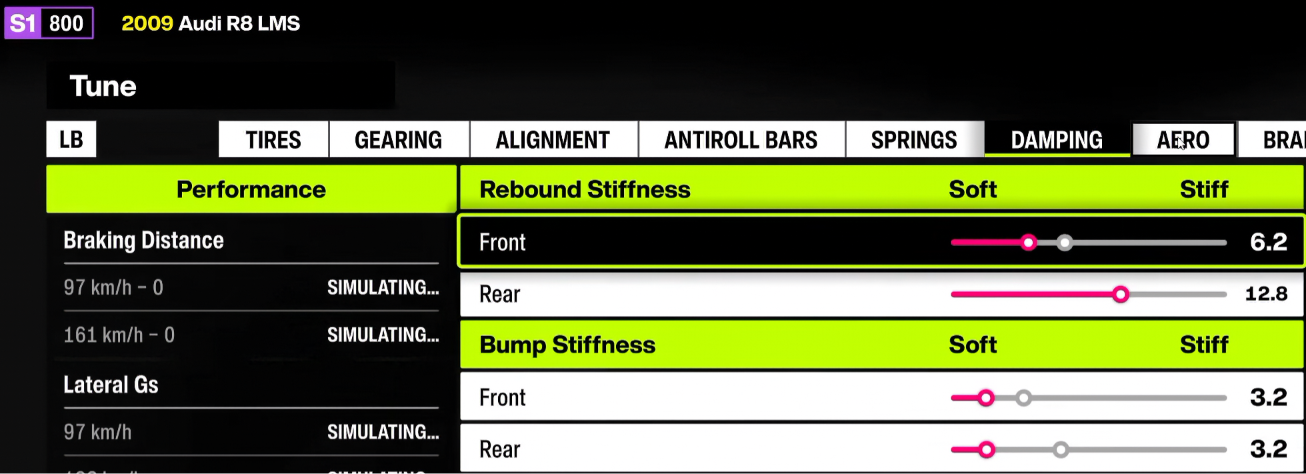
| Damping | Bump 3.0-3.4 baseline, special value 4.7 / Rebound 7.5-11.5 | Bump 3.1~3.5 / Rebound F 6.2~9.2, R 7.6~16.8 | Nalak28 bump values cluster in the low 3s. The K1Z Bard Viper is very tidy at rebound 9.8/9.8 and bump 3.0/3.0. |
| Differential | AWD 100/0, 100/2~4, Center 85~97 / RWD Rear 50/0 | AWD 100/0, 100/0, center about 60-90 / RWD rear 100/0-4 | The K1Z Bard Viper is unusual at front accel 60, but rear 100/5 and center 85 sit inside the observed range. As rear/center differential evidence, it is a useful support sample. |
THIRD TUNER SAMPLE
This is a single 2008 Dodge Viper SRT-10 ACR sample. It does not replace the LetzeLU/Nalak28 baseline; it is only supporting evidence for checking whether damping, spring R/F, and differential rear/center match the existing observations.
| Area | Value | How to read it |
|---|---|---|
| Car | 2008 Dodge Viper SRT-10 ACR · A 700 | It is only one public sample, so this should not become a rule. Use it only as a counter-sample for checking the LetzeLU/Nalak28 patterns. |
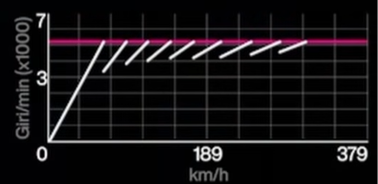
| Gearing | FD 2.74 · 4.17 / 2.95 / 2.31 / 1.88 / 1.58 / 1.33 / 1.13 / 0.99 / 0.89 | It keeps much of the same base gear set as the Nalak28 FXX and appears to set overall length with Final Drive plus the very top gears. |
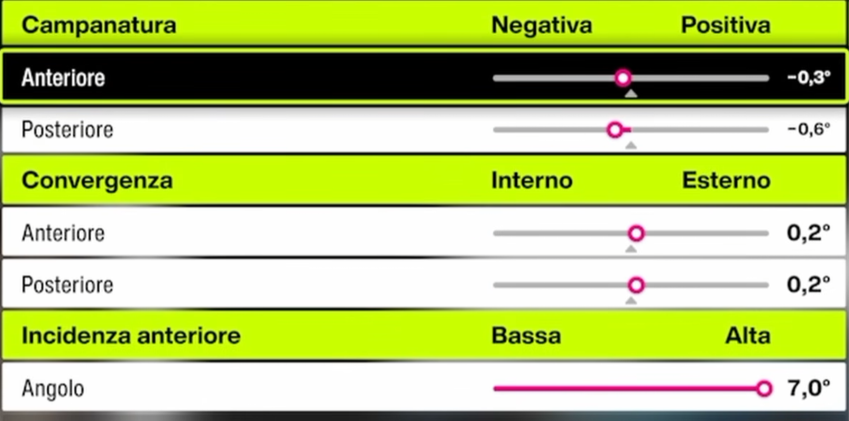
| Alignment | Camber -0.3 / -0.6 · Toe 0.2 / 0.2 · Caster 7.0 | This is a counter-sample to fixed 0/0 toe. Because camber order and UI language can vary, keep it as a supporting record until more samples confirm it. |
| ARB | Front 13.5 / Rear 65 | This departs from the 1/65 pattern. One possible read is that it corrects the mechanical balance toward about 0.65. |
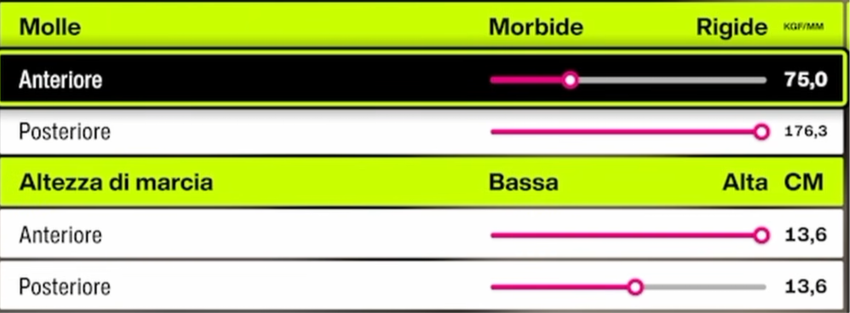
| Springs / Ride | Spring F 75.0 / R 176.3 · Ride F 13.6 / R 13.6 | Rear spring is 2.35x. Ride height is equal front/rear, but the direction still matches the stronger-rear-spring tendency seen in Nalak28 samples. |
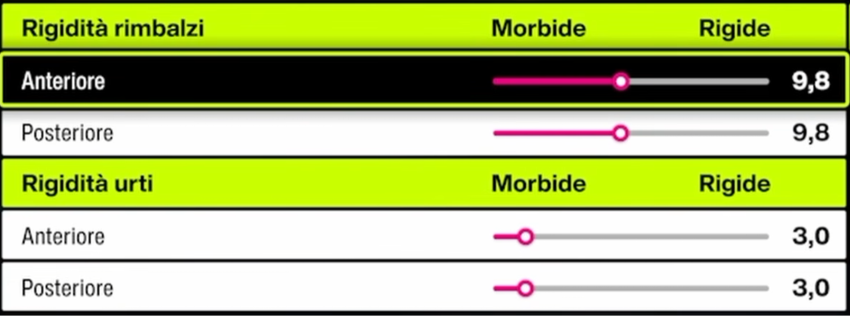
| Damping | Rebound 9.8 / 9.8 · Bump 3.0 / 3.0 | This is a cleaner symmetric value set than LetzeLU. Rebound is about 3.27x bump, which fits the existing range well. |
| Aero | Front max / Rear min · Aero balance 0.56 | Aero Balance is further rearward than our recommended axis. For aero, keep this only as an exception sample. |
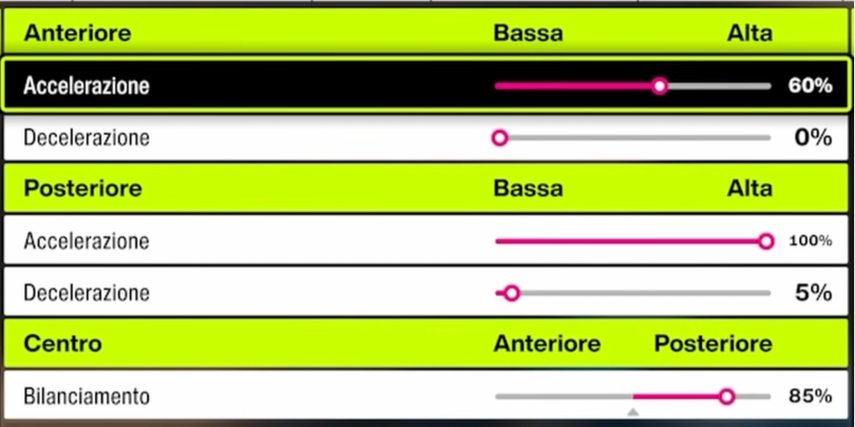
| Differential | Front 60/0 · Rear 100/5 · Center 85 | Front accel 60 is unusual, but rear 100/5 and center 85 fit the LetzeLU/Nalak28 observed range well. |
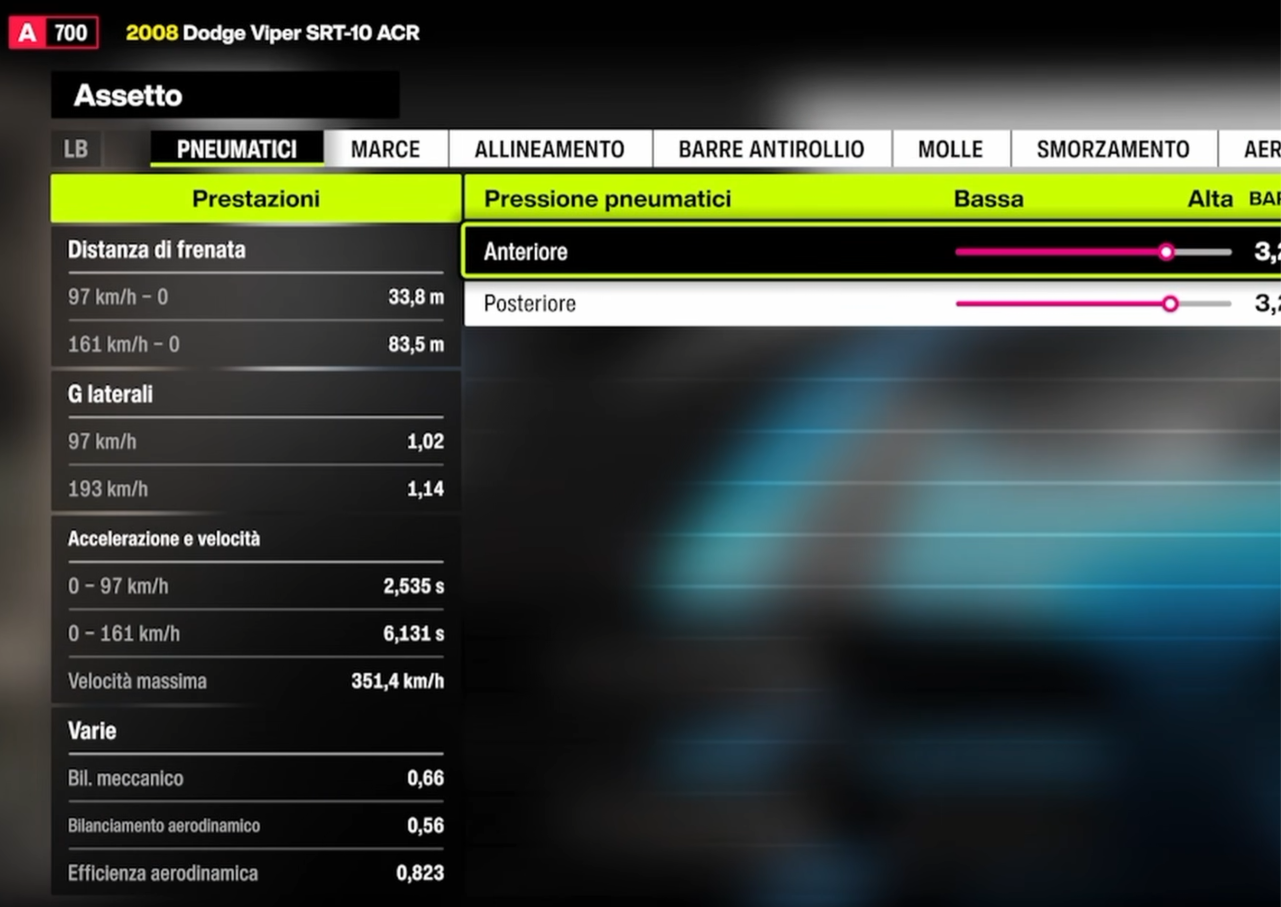

The Nalak28-style values are based on limited observed samples. Damping should be narrowed as the sample set grows, and observation notes should stay separate from measured meta-tuner values.
| Source | Car | Class | Front | Rear | F-R | Spring R/F | Memo |
|---|---|---|---|---|---|---|---|
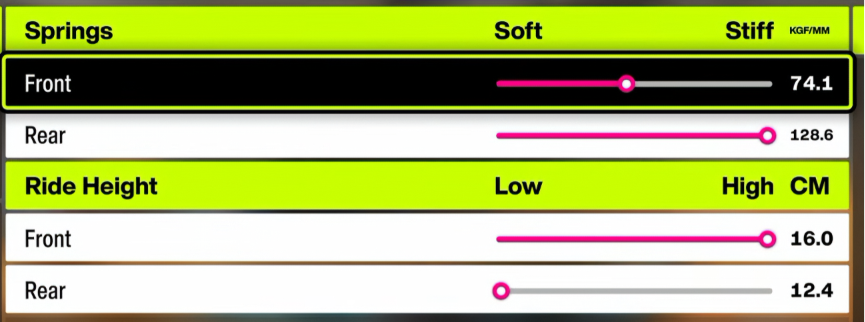
| LetzeLU | 2021 McLaren 620R | S1 800 | 16.0cm | 12.4cm | 3.6cm | 1.74x | F max / R min |
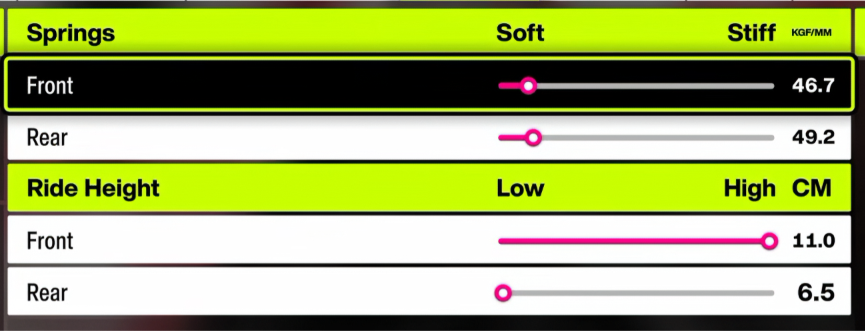
| LetzeLU | 2004 Honda S2000 WTAC | S2 900 | 11.0cm | 6.5cm | 4.5cm | 1.05x | F max / R min |
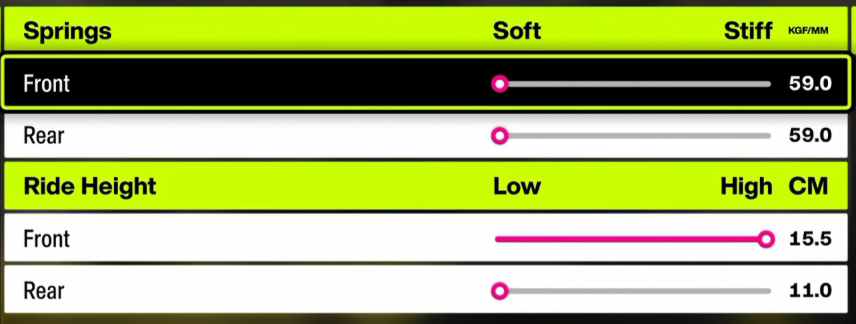
| LetzeLU | 2024 Chevrolet Corvette E-Ray | S1 800 | 15.5cm | 11.0cm | 4.5cm | 1.00x | F max / R min |
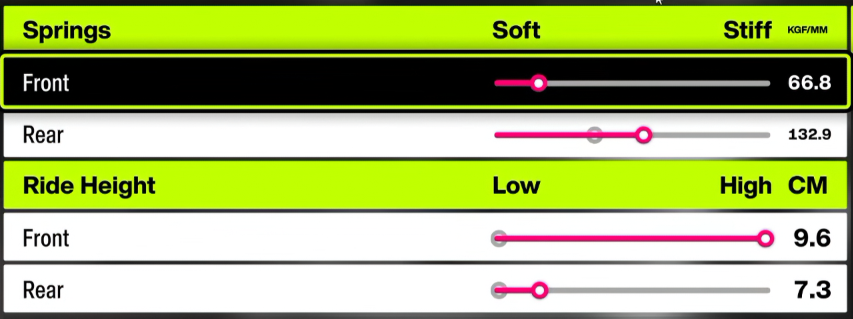
| Nalak28 | 2009 Audi R8 LMS | S1 800 | 9.6cm | 7.3cm | 2.3cm | 1.99x | Low F-R difference sample |
| Nalak28 | 2022 Maserati MC20 | S1 800 | 14.7cm | 12.0cm | 2.7cm | 1.85x | Low F-R difference sample |
| Nalak28 | 2010 Lamborghini Murcielago LP 670-4 SV | S1 800 | 10.6cm | 7.1cm | 3.5cm | 2.15x | Near the midpoint |
| Nalak28 | 2018 Chevrolet Camaro ZL1 1LE | S1 798 | 17.0cm | 13.9cm | 3.1cm | 0.91x | Lower rear spring exception |
| Nalak28 | 2020 Ferrari SF90 Stradale | S1 800 | 12.6cm | 9.8cm | 2.8cm | 2.31x | Stronger rear spring sample |
| Nalak28 | 2011 McLaren 12C Coupe | S1 800 | 12.1cm | 8.0cm | 4.1cm | 1.79x | Large F-R difference |
| Nalak28 | 2005 Honda NSX-R GT | A 700 | 16.7cm | 12.7cm | 4.0cm | 1.43x | Large F-R difference |
| Nalak28 | 1994 Toyota Celica GT-Four ST205 | A 700 | 17.6cm | 14.8cm | 2.8cm | 1.63x | Low F-R difference sample |
| Nalak28 | 2009 Chevrolet Corvette ZR1 | S1 800 | 14.0cm | 9.7cm | 4.3cm | 1.76x | Large F-R difference |
| Nalak28 | 1972 Datsun 240Z | R 998 | 13.0cm | 7.5cm | 5.5cm | 1.04x | Special R-class exception |
| K1Z Bard | 2008 Dodge Viper SRT-10 ACR | A 700 | 13.6cm | 13.6cm | 0.0cm | 2.35x | Equal ride height + stronger rear spring |
The three LetzeLU cars cluster at F-R 3.6-4.5 cm, while ordinary Nalak28 samples mostly cluster around 2.7-4.3 cm.
Do not read ride height from absolute cm values alone; read the front/rear slider position together with the F-R difference.
GEARING GRAPH
Final 2.86 · 7-speed
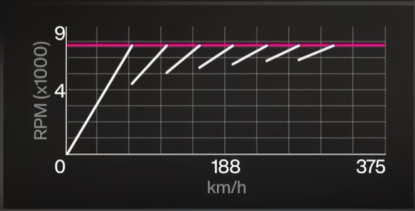
7-speed. A long 1st gear, then tight spacing from 2nd onward for high-speed road use. This sample leaves the most top-speed room.
Final 4.03 · 7-speed
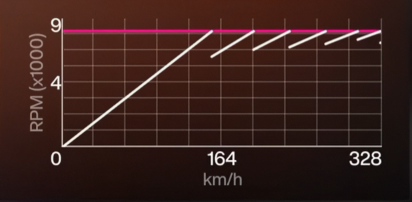
7-speed RWD. 1st is very long, then the later gears stay close to redline. It looks tuned to reduce straight-line loss for the Shirakawa lap.
Final 3.38 · 8-speed
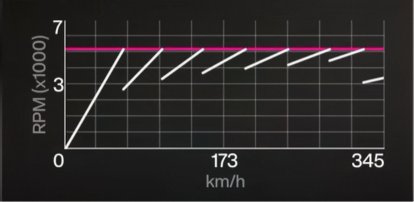
8-speed. In practice it uses 1st through 7th tightly, while 8th looks like an overdrive gear that is mostly left unused.
Use the graph to read spacing between gears, not just the raw numbers. LetzeLU-style gearing seems to place the real course speed bands near redline rather than spreading every gear evenly. If the last gear sits far too long, it may be a throwaway gear rather than a gear used in practice.
NALAK28 GEARING
| Gear | Initial | Final | Change | Memo |
|---|---|---|---|---|
| Final Drive | 4.11 | 2.57 | -1.54 | Adjusted from the initial compressed state to the final overall length |
| 1st | 4.17 | 4.17 | 0 | Individual ratio held. Actual gear length gets longer because of Final Drive. |
| 2nd | 2.95 | 2.95 | 0 | Individual ratio held |
| 3rd | 2.31 | 2.31 | 0 | Individual ratio held |
| 4th | 1.88 | 1.88 | 0 | Individual ratio held |
| 5th | 1.58 | 1.58 | 0 | Individual ratio held |
| 6th | 1.33 | 1.39 | +0.06 | Upper gear pulled shorter |
| 7th | 1.13 | 1.24 | +0.11 | Upper gear pulled shorter |
| 8th | 0.90 | 1.13 | +0.23 | Pulled into usable range instead of leaving it as a throwaway gear |
| 9th | 0.75 | 1.03 | +0.28 | Top end pulled in strongly |
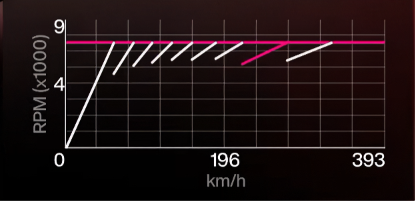
Starts at FD 4.11. The whole set is compressed short, making any odd upper-gear gap easier to see.
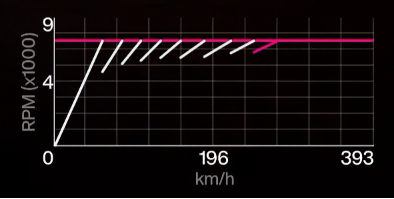
Five seconds later in capture order. An intermediate graph for visually checking gear spacing.
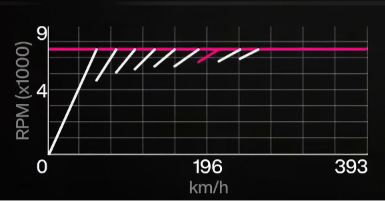
The flow is now touching the upper gears. Do not treat the intermediate values as confirmed records.
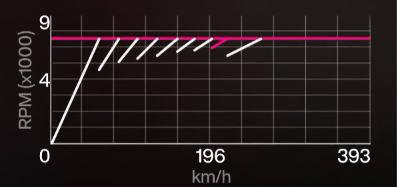
The upper-gear spacing is being cleaned up.
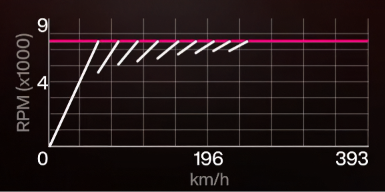
An intermediate state where the top gears are being pulled closer.
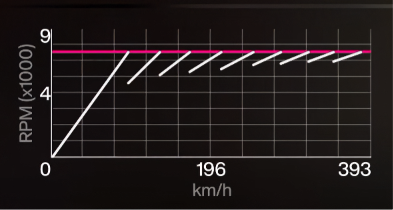
Final value at FD 2.57. After cleaning up the upper gears, the overall length is stretched back to match real course speed.
Working hypothesis: when Final Drive is moved extremely short, the graph compresses and odd upper-gear gaps become easier to see. Clean up only those upper gears first, then use Final Drive at the end to reset overall length. The result reads like a curve that tightens toward the top. This is not a general theory yet, only an adjustment note for reading this sample.
OBSERVED WORKFLOW
First, move Final Drive far toward the shorter side to compress the graph. In that state, the gear gaps look tighter, making it easier to spot a single upper gear that sticks out.
Keep 1st through the middle gears as close to the transmission's base values as possible. The read is to preserve the natural curve of the base gear set rather than forcing a new low-speed section.
If one upper gear sits far away in the compressed graph, pull only that gear shorter. The goal is not to throw away the last gear, but to create a curve that gets tighter toward the top.
After the upper gears are cleaned up, move Final Drive again to match real course speed. Only after this step do you have the final ratios.
This flow summarizes a Nalak28-style gearing adjustment observed several times. It is not a rule for every car yet; treat it as a repeated observation pattern for reading S1 800 road samples.
NALAK28 S1 ROAD SAMPLES
FD 3.13 · 9-speed
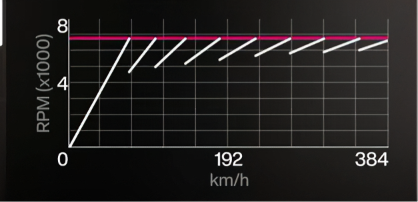
9-speed. FD is 3.13, and the upper gears narrow consistently so the full set stays usable.
FD 2.41 · 10-speed
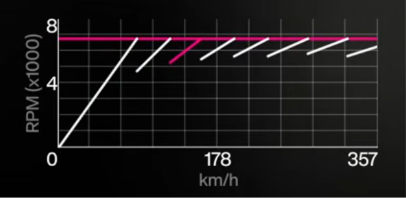
10-speed. FD is stretched out to 2.41, while the individual ratios stay close to a tight base set.
FD 3.15 · 10-speed
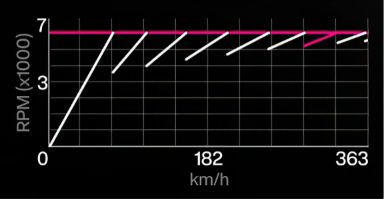
10-speed. FD is 3.15, and after 2nd gear the curve drops faster than the other samples.
FD 3.14 · 10-speed
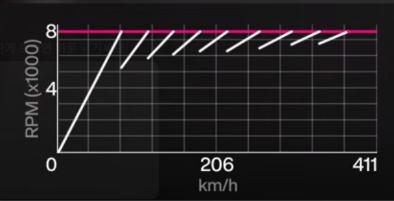
10-speed. 9th and 10th are tied at the same value, an unusual sample that does not spread the very top end apart.
FD 3.58 · 10-speed
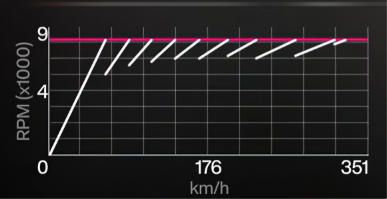
10-speed. Gears 1-9 are almost the same base set as the Porsche 935, with the difference made through FD and the last gear.
RAW VALUES
| Item | 2021 McLaren 620R | 2004 Honda #52 Evasive Motorsports S2000 WTAC | 2024 Chevrolet Corvette E-Ray |
|---|---|---|---|
| Tires |
|
|
|
| Gearing |
|
|
|
| Alignment |
|
|
|
| ARB |
|
|
|
| Springs |
|
|
|
| Damping |
|
|
|
| Aero |
|
|
|
| Brakes |
|
|
|
| Differential |
|
|
|